Institute of Social Sciences, Branch 4, Lebanese University
From the Static to the Dynamic: Haqqi Awrath Association as a Model
Auguste Comte’s Law of the Three Stages has long constituted fertile ground for debate. It explains the transition from the theological stage to the metaphysical stage and then to the scientific stage as a movement from the “static” to the “dynamic,” before a new form of stability emerges with the consolidated scientific stage. Theoretically, this framework requires imagination and reflection; practically, however, it has been clearly embodied in the experience of Dr. Ouloum AOUDE, a native of the village of El-Khoder in the Baalbek district.
In a social environment where deprivation from inheritance was widely accepted simply because the affected individuals were women, Dr. AOUDE transformed this static reality into an active dynamic. The turning point came when she raised her voice against those closest to her—against her own father—rejecting the notion that her brothers should receive the “lion’s share” of the inheritance while she and her sisters were marginalized, despite their high academic qualifications and their active participation in agricultural fieldwork and domestic labor. Attempts to placate them with token material compensation fell far short of justice.
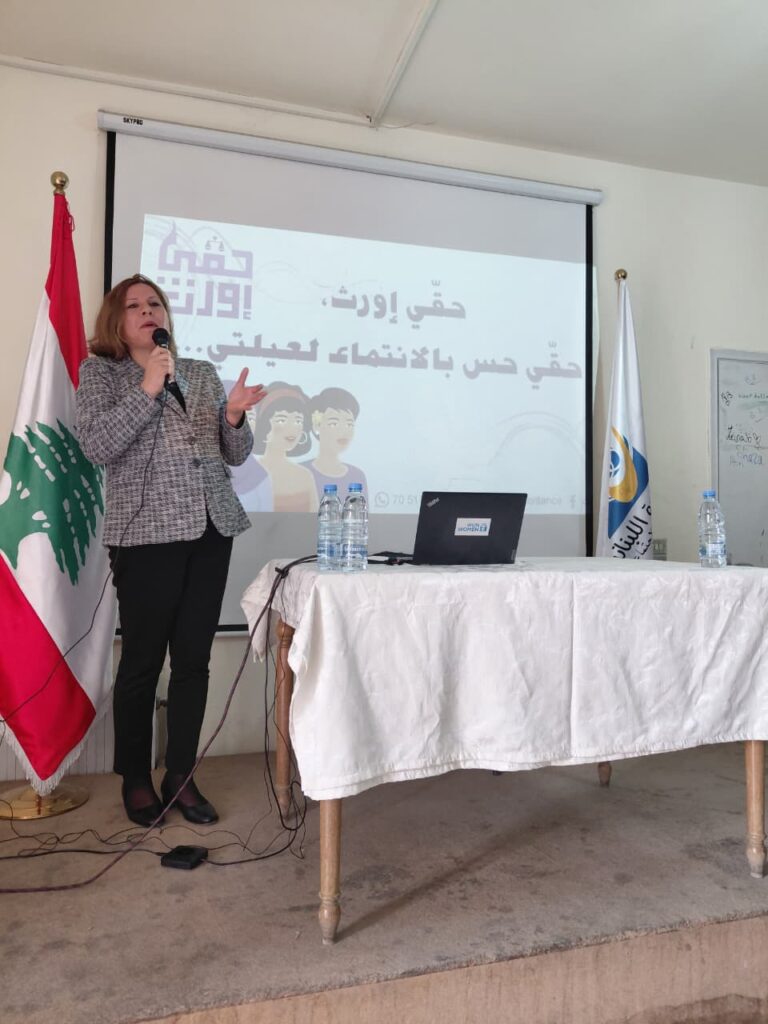
In coordination with the Institute of Social Sciences at the Lebanese University (Branch 4 in Zahle), the Lebanese Sociological Association, the Strategic Forum for Research and Studies, and Blossom of Joy Association, Dr. Ouloum AOUDE was hosted in a seminar held at the Institute of Social Sciences in Zahle. During the event, she presented—candidly and clearly—the details of her personal journey, which led her to establish the “Haqqi Awrath” Association, officially registered since early 2021. Through this platform, she succeeded in encouraging women to break their silence and raise their voices against injustice—starting in El-Khoder, expanding to the Bekaa, then to Lebanon as a whole, and subsequently to other Arab countries—building on notable success and wide acceptance among women eager to express the denial of their legitimate rights.
The seminar was opened by the Director of the Institute, Dr. Dalida Al-Bitar, and introduced by Dr. Fidaa Bou haidar, President of the Lebanese Sociological Association. Alongside Dr. Ouloum AOUDE, the event was attended by Dr. Maroun Makhlouf, Vice President of the Strategic Forum for Research and Studies, who delivered a speech addressing women’s historical suffering and their long struggle over the past two centuries to secure their rightful place as active and capable contributors—on par with men—in all fields of scientific and professional life.
Dr. Naji Ali Ayoub, a specialist in local law, also intervened with a presentation on the inheritance legislation adopted by the various religious communities in Lebanon, both Christian and Muslim. He clarified how religious and sectarian legal frameworks view women and their inheritance rights, noting that Lebanese civil law establishes equality between men and women and grants women the same rights as their brothers. However, he emphasized that prevailing social beliefs and traditions across Lebanon’s communities often constitute the strongest barrier to the application of these laws or are used to circumvent them.
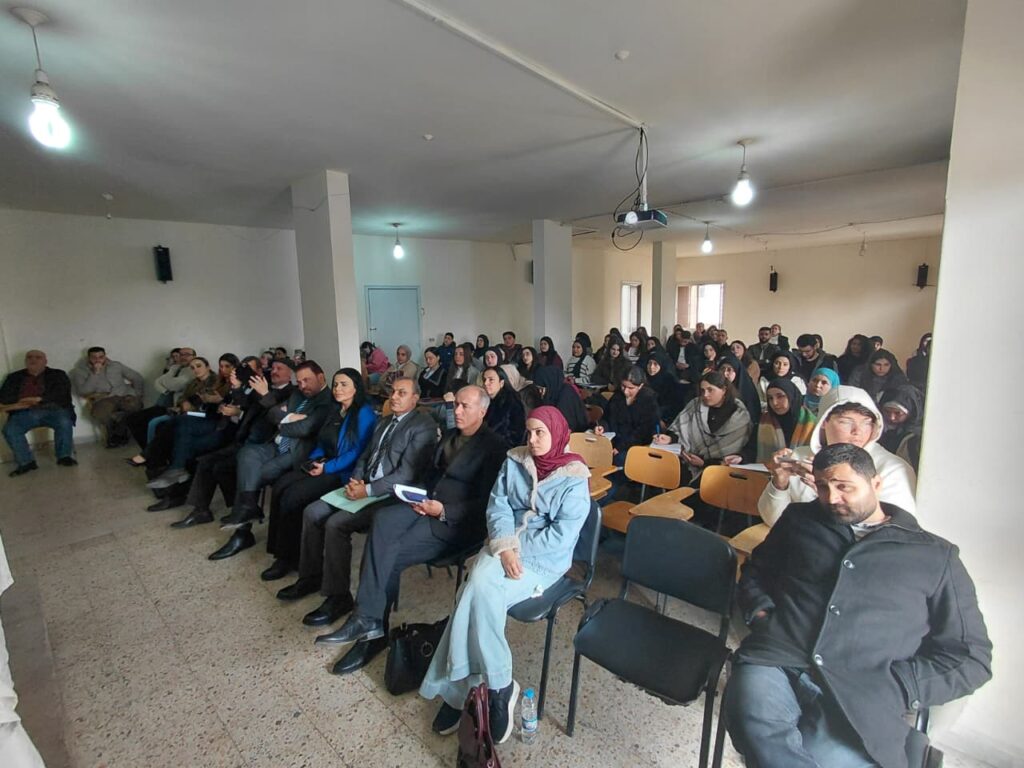
The seminar was attended by a large audience of colleagues, students, and staff members. The interventions and questions enriched the discussion and encouraged all participants not to remain silent in the face of injustice, regardless of its form, and to raise their voices whenever individual rights are violated. The photographs taken during the event vividly reflect the high level of engagement that characterized both the presentation and the discussion.
No comment